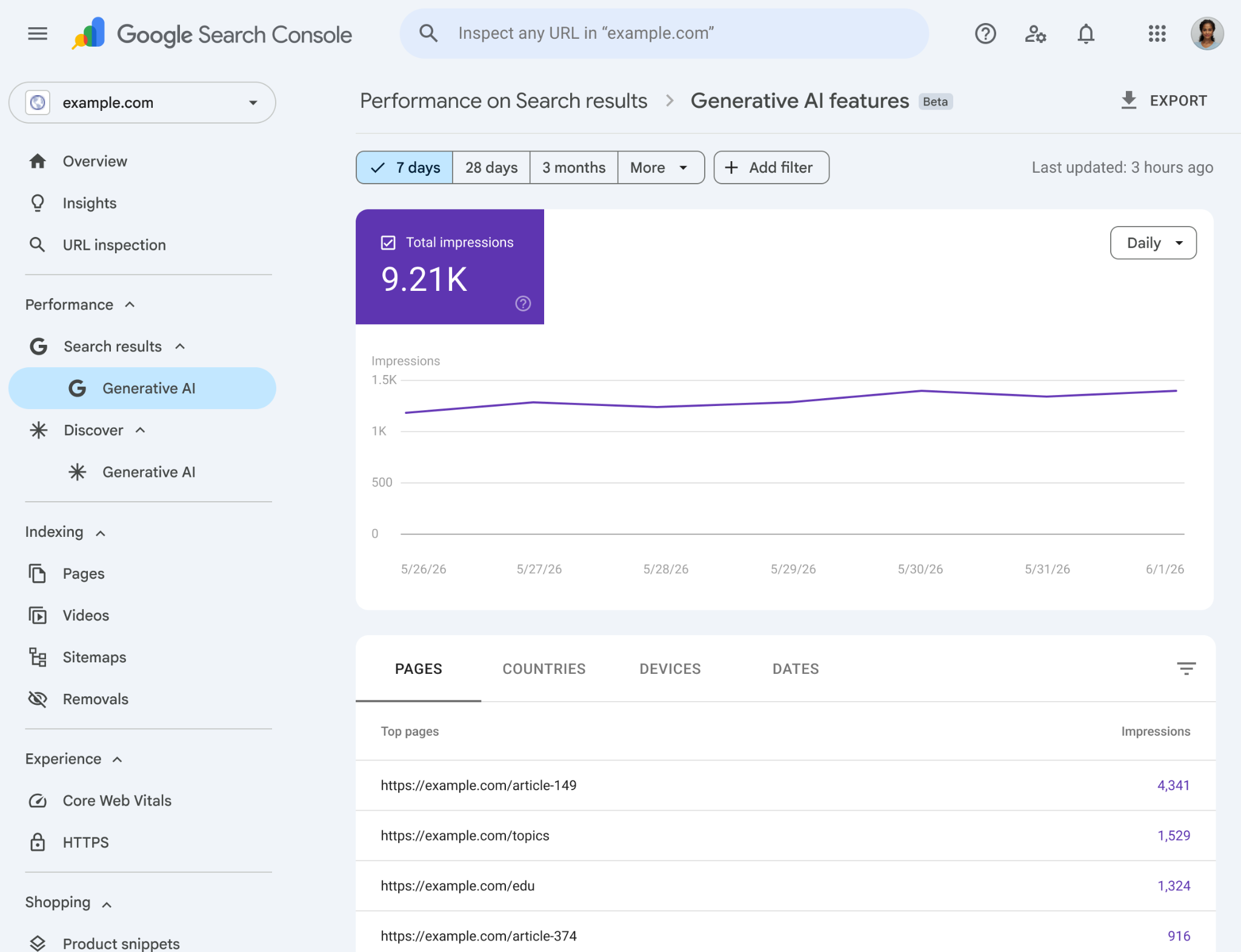
On 3 June 2026, Google quietly closed one of the biggest blind spots in modern search. Search Console now has dedicated Search Generative AI performance reports, separate views that show how often your pages appear inside AI Overviews and AI Mode on Search, and inside generative AI features in Discover. For the first time, the visibility that answer engines have been quietly handing out, or withholding, is something you can actually see in a report.
Until now, AI-feature impressions were folded into the overall Performance report with no way to isolate them. You could watch traffic patterns shift and guess that AI Overviews were the cause, but you could not prove it. The new dedicated view changes that, and for D2C brands betting on answer-engine optimisation, it is the measurement layer that was missing.
What the new reports actually show
Google is rolling the reports out to a subset of websites first, testing and gathering feedback before a wider launch, so do not panic if you do not see them yet. Where they are live, they break your generative-AI visibility down five ways:
- Impressions, how often URLs from your site appeared in generative AI features across Search and Discover.
- Pages, exactly which URLs are being surfaced inside AI features.
- Countries, your AI visibility on a country-by-country basis.
- Devices, what people are using when they see you (Search results only).
- Dates, performance over time at hourly, daily, weekly and monthly granularity.
Google is rolling the reports out to a subset of websites first, testing and gathering feedback before a wider launch, so do not panic if you do not see them yet.
The catch every brand should read twice
Look closely at that list and notice what is missing: clicks. The launch reports measure impressions, appearances inside an AI answer, not visits. That is not an oversight; it is the nature of answer engines. When an AI Overview summarises your page, the shopper often gets what they need without clicking through. Impressions become the leading indicator of influence, and the click becomes a smaller, lagging part of the story.
For D2C brands this reframes the goal. The question is no longer only “how much traffic did we get?” but “how often are we the source the AI chose to cite?”, because being named in the answer shapes the purchase even when no click is ever recorded.
What to do with it now
Treat these reports as the scoreboard for your AEO work, the discipline of becoming a cited, quoted source inside AI answers.
- Request and watch the dedicated view as it rolls out; the same data is already feeding your overall Performance report.
- Track impressions by page to learn which content the AI engines actually trust, then make more of it.
- Watch the country splits if you sell across markets; AI visibility is far from uniform by region.
- Pair the data with clear answers, structured content and schema, the page-level signals that earn citations in the first place.
Google has been candid that more metrics will come; this is a first release, deliberately limited. But the direction is unmistakable. Measurement always follows the money, and Google building a dedicated report for AI-feature visibility is the clearest signal yet that being found inside AI answers is now a channel to manage, not a curiosity to watch. The brands that start measuring it today are the ones that will be optimising it tomorrow.